November 6, 2026
Industrial IoT Network Segmentation for Malaysian Factories and Smart Buildings

Connected factories and buildings rely on sensors, gateways, controllers and dashboards to provide operational visibility. Connecting devices without a network plan can create unnecessary pathways between office computers and equipment that affects physical processes. Industrial IoT network segmentation limits those pathways while preserving communications required for safe, reliable operations. It is one part of a wider security programme rather than a standalone guarantee against cyber incidents.
Understand IT and operational technology
Information technology supports email, business applications and office networks. Operational technology, or OT, monitors or controls physical processes such as pumps, air-handling systems, production equipment and building automation. The two environments may exchange data, but their safety and availability requirements differ. A software change that is routine on an office laptop may be unsuitable for a controller operating a production line. Involve operations personnel from the beginning.
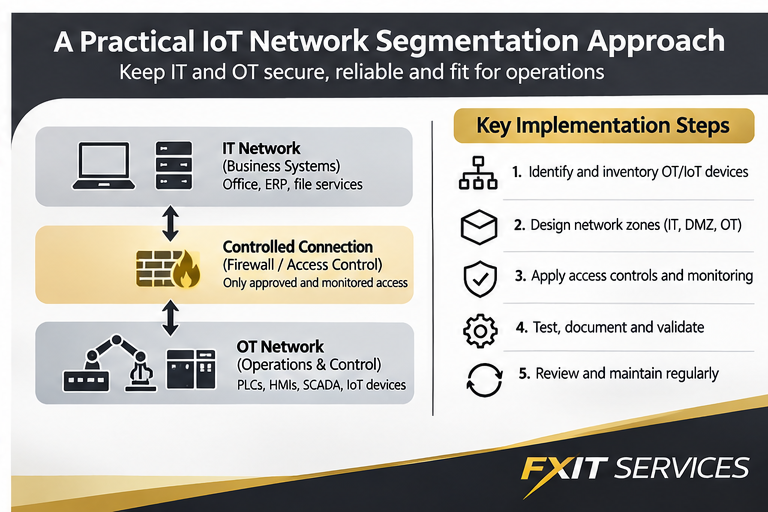
Inventory devices before changing rules
Record sensors, gateways, PLCs, human-machine interfaces, supervisory systems, engineering workstations and cloud-connected applications. Note each device owner, vendor support status and operational criticality. Include maintenance laptops and building management systems that are easily overlooked. A reliable inventory helps identify required connections instead of simply blocking unfamiliar traffic. Check whether devices use fixed addresses, specialised protocols or vendor-managed remote access.
Map legitimate data flows
For each connection, document the source, destination, protocol, purpose and operational impact if unavailable. A sensor gateway may need to send telemetry without allowing a dashboard to issue control commands. A vendor support session may be needed only during a maintenance window. Separate read-only monitoring from privileged configuration functions. Review these assumptions with the equipment vendor and the person accountable for plant operations.
Create meaningful security zones
The NIST Guide to OT Security, SP 800-82 Revision 3 discusses segmentation as part of defence in depth. Facilities may separate office IT, OT supervisory systems, controllers, safety-related systems and external services. VLANs provide logical separation, while critical environments may justify physical separation. The right architecture depends on equipment constraints, operational risks and a documented assessment rather than a universal diagram.
Control traffic between zones
Use properly configured gateways and firewalls to permit necessary communications and restrict unnecessary ones. Consider controlled intermediary networks for external data access rather than exposing controllers directly to the internet. Log important connections and review exceptions. Never apply blanket blocking without checking dependencies: loss of communications can interrupt production or building services. Changes should have approval, a maintenance window, a rollback plan and a named responsible person.
Treat remote access carefully
Remote maintenance is useful when vendors support sites across Malaysia, but it should not mean permanently open access. Define who can connect, from which devices, for what purpose and for how long. Use strong authentication, least-privilege access and session records where supported. Remove obsolete vendor accounts and review temporary permissions after maintenance. Older OT devices may lack modern security features, requiring protective controls around them.
Validate monitoring data
An IoT dashboard may display temperature, vibration, power or equipment state. These readings can help staff investigate abnormal conditions, but a chart does not prove that a sensor is calibrated or a process is safe. Validate accuracy, timestamps, connectivity and alert thresholds. Define who may change setpoints and who investigates an alert. Keep the operational source of truth clear and avoid automatic control actions without an approved safety assessment.
Pilot without disrupting operations
Choose a limited system for a segmentation review. Map normal communications, propose a boundary and assess the effect of failed connectivity. Test in a safe environment or approved maintenance window. Document connectivity, alarms and recovery steps before and after changes. Involve the operator, integrator and manufacturer as appropriate. Avoid aggressive scanning of production controllers without permission, since some devices are sensitive to unexpected traffic.
Guidance versus legal requirements
NIST SP 800-82 Revision 3 was published in September 2023 as US technical guidance, not an automatic Malaysian legal mandate. The CISA segmentation guide describes the value of boundaries between IT and OT. Whether a particular Malaysian facility has additional legal, contractual or sector requirements depends on its circumstances. Verify these obligations separately.
Next steps with FXIT
FXIT’s IoT solutions page and IT services page are starting points for discussing connected operations. Request a quotation with your device types, locations, existing network and monitoring objectives. Any security design should be assessed by qualified specialists against the actual environment.
Sources checked 6 November 2026
NIST SP 800-82 Revision 3 final; CISA Layering Network Security Through Segmentation. These are guidance sources, not a claim of certification.
An operational handover checklist
Before accepting a new IoT connection, document the responsible system owner, the approved device inventory, network diagram, firewall rules, remote-access method, monitoring contacts and emergency rollback procedure. Check that the operations team knows what normal traffic and sensor behaviour look like. Keep vendor support details and backup configurations available if a gateway fails. Set a date to review rules after commissioning, because temporary exceptions can otherwise become permanent. When a device is retired, remove its credentials and access rules as part of the same change. A clear handover makes future troubleshooting safer and reduces dependence on a single technician.
Visual workflow summary